Base The solar kiln base (foundation and floor joists) is pretty straightforward construction. The lot where I built the kiln was a gravel parking space many years ago so the ground is mostly a gravel and dirt mix. This combined with the fact that the kiln may need to be moved at some point (hopefully not) made the use of a skid foundation the obvious choice. The foundation is made up of two treated 6x6s, 12 feet long. I chamfered all four of the bottom edges and drilled large holes in each end. The chamfers will hopefully make dragging the kiln easier and the holes may be used as attachment points. Once the skids were positioned and leveled, the floor framework was built with treated 2x8s. The skids were used as a construction platform, but the floor joists were not nailed to the skids. The Virginia Tech plans call for double rim joists, but since all of the joists rest directly on the skids and none are "hung" from the rim joist, I figured a single rim joist would be fine. Plus it saved me a few dollars. With the floor framework complete it was time to move on to the flooring. The first plywood to be nailed down will become the bottom of the floor framework. Here I used three sheets of 1/2" treated plywood. Remember to save the offcuts, they'll come in handy down the road. Once the plywood is installed it was time to flip the entire floor assembly. Although I muscled this monster over by myself, I would strongly suggest getting a friend to help flip it and reposition it on the skids. The flipped flooring framework (say that three times fast) was repositioned on the skids and then nailed to the skids. I nailed directly through the plywood into the skids and toe-nailed the joists to the skids as well. Insulation was installed between all of the flooring joists. Defense in depth is the strategy for keeping moisture out of the insulation. The craft paper was covered by black plastic vapor barrier stapled to the rim joists. Three more sheets of treated plywood were cut to length and installed over the vapor barrier. |


| Framing Framing for the solar kiln began with a truckload of 2x4s of various lengths as called out in the VT plans. The first wall I built was the front or south wall. Nothing fancy, just normal framing 16" on center. One minor change I made from the VT plans was to utilize a three stud corner instead of the specified four stud corner. The three stud corner allows just a little bit more insulation in the corner to help decrease some of the heat loss through the studs. North wall framing began by constructing the built up beam that will serve as the door header. Two 2x8s, some of the 1/2" plywood offcuts, and about a billion nails completed the beam. The north wall was framed while laying flat on the kiln floor. Since this was a one man operation, I added some additional, temporary studs to the outer edges for the lift. It was easiest to use the south wall as stop and use the truck to slowly raise the wall. Once it was vertical two support studs were nailed to each side. These studs allowed me to slowly "walk" the wall back one side at a time, little by little without the fear that it would tumble down north or south. I would just lift up the support on the north side, drag one end of the wall a foot or so towards the north and let the south support drag the ground. Go to the other end and do the same thing. Repeat, repeat, repeat...... When the wall was flush with the north edge of the floor, it was nailed in place and a temporarily attached to the north wall. No special framing was done on the south wall to help with insulation. I figured I would need plenty of studs to hold the beam and hold the door hinges. With the south wall and north wall complete, the two side walls were next. Some 45 degree cuts on the top were about the most complex part of the side wall framing. It was a good time to think about the stud placement relative to the outer edges of the north and south walls. Locate the side wall studs so the edge of a full sheet of sheathing can fall on the center of a stud. The second sheet can then be cut to fit. This helps keep down the number of cuts on the sheathing. Assuming the north and south wall are parallel and plumb, it made it easy to build the side walls laying flat on the floor between the north and south walls. The roof framing is made up of 2x4s at 24 inches on center. This framing was a bit more challenging as it required more angle cuts. |


 The terms relating to position of decay in the tree are just approximations; the fungi are not necessarily restricted to these regions.

 Cabinet shop owners are now showing samples of this superb species to more customers and getting excellent feedback. In smaller projects, you'll find that wenge is excellent for contrast against medium tone woods such as oak, cherry, koa, and more. When you find good quality wenge veneer, it is because a veneer mill properly "cooked" the log prior to slicing it. This species is among the most difficult logs to slice. The wenge tree grows to 90 feet high and have a diameter of more than 36 inches. Wenge is in relatively short supply but the price has remained affordable.
 Walnut burl is a classic beauty. It is used on everything from fine furniture to automobiles. The rich brown color is frequently accented with a light coat of penetrating stain which brings out the figure. Walnut is one of only a handful of species that lightens with exposure to UV light. Vintage walnut furniture pieces are usually very warm in color. The lightening process can take months, years, and even decades to achieve.
 Walnut burl is a classic beauty. It is used on everything from fine furniture to automobiles. The rich brown color is frequently accented with a light coat of penetrating stain which brings out the figure. Walnut is one of only a handful of species that lightens with exposure to UV light. Vintage walnut furniture pieces are usually very warm in color. The lightening process can take months, years, and even decades to achieve.
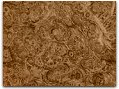 Walnut burl is a classic beauty. It is used on everything from fine furniture to automobiles. The rich brown color is frequently accented with a light coat of penetrating stain which brings out the figure. Walnut is one of only a handful of species that lightens with exposure to UV light. Vintage walnut furniture pieces are usually very warm in color. The lightening process can take months, years, and even decades to achieve.
 European walnut is blanket name that covers a wide variety of walnut lumber and veneer from Europe. The most common woods found under this category are French, Italian, Circassian, and Russian walnut. The finest European walnut burl veneer comes from trees which are hand-dug from the ground (the burl growth is commonly found at or below the ground level).
 Tamo ash is one of the most highly figured veneers available. It has a rolling figure similar to "quilt" but the shimmer is much stronger. This figure is often called "peanut" which is does not effectively describe the beauty of this veneer. Even in pictures, the iridescence does not fully show. Customers have described it as "3D" and compared it to water cascading over glass. Lesser figured tamo ash is used today as construction lumber in Japan!
 Sapele is a member of the mahogany family and like mahogany, this deciduous species grows quite large...up to 150 feet tall. Quartersawn sapele veneer is very even in color and grain. The highly sought-after pommele ("pom-el-LAY") sapele is stunning. Pommele sapele resembles rain drops cascading down a pane of glass. True quilted sapele is also in high demand because of its intense 3-D grain orientation.
 Redwood is a close cousin of the famous sequoia tree of California. Certainly the most prized growth/grain in redwood is burl which generally grows underground and must be excavated with specialized machinery. Typically used on automotive dashboards and small case goods, redwood burl has a pleasant color and shimmer when top coated with lacquer or oil-based polyurethane. It is such a beautiful wood, that it is hard to believe it's not an imported burl species!
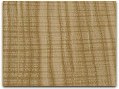 This striking display of color is remarkable among our veneer inventory. Our resources tell us that Olive Ash is not a true botanical species, but instead is simply an occurrence (within the European Ash family) where the heart of the tree grows abnormally causing alternating colors in the annual growth rings. This "beauty of the forest" is excellent for door panels, carcass work, and small furniture pieces.
 Mappa burl has wonderful color combination that often varies from light tan to a beautiful gold with dark red/brown burl pockets. Mappa veneer also has a very unique aroma which is striking similar to the smell of leather. Originally from Western Europe, mappa is the only species of poplar that develops this rare type of burl formation. Mappa burl veneers typically require a grain filler to level-out the voids in the burl pockets.